Why this matters in Centreville
Census Bureau survey data for the Centreville census-designated place counts more single-family attached homes than detached ones, with a median year built of 1990 (ACS 2024 1-year, via Census Reporter). A lot of those townhouse rows are now reaching the age where owners start replacing roofs, but rarely all at once. That's what makes townhouse roofing its own problem.
Start with ownership: whose roof is it?
Before anything else, find out who owns the roof. In a typical fee-simple townhouse community, each owner owns the roof over their unit and the association reviews appearance. In a condominium, the roof is often a common element. Fairfax County's Community Association Guide describes condominiums as structures where parts such as the roof are owned and shared by all unit owners. If that's your situation, the association arranges and pays for the roof, and your role is to report problems. Your deed, declaration and association documents answer this.
Where your section starts and ends
On most townhouse rows, the line between roofs sits over the party wall, the wall between units. From the street the roof looks continuous, but your section is the stretch above your unit, between the two walls. Your scope should say exactly where the tear-off stops, and the crew should stop there. Ripping into a neighbor's shingles to make a tidy seam isn't something to decide on installation day.
Party walls and fire-rated sheathing
The walls between townhouses are built to slow fire spreading from one unit to the next, and the roof assembly near them is part of that. Fairfax County's permit guidance notes that roof plywood may be "required to be fire rated, such as townhomes," and excludes that case from the small-repair exemption. If decking near the party wall is damaged and has to be replaced, it may need to be fire-rated material, and a permit may be needed. A roofer who works on townhouses should raise this before tear-off, not after.
Tying into a neighbor's older roof
When only your section is replaced, the new shingles have to meet the neighbor's older ones cleanly. That joint is one of the most common leak points on a townhouse row. Good practice is to weave or lap the underlayment and shingles at the seam so water can't get under either roof, and to leave the neighbor's roof in the condition it was in. Expect a small color difference at first: new shingles next to 20-year-old ones never match perfectly, even in the same product line.
Talk to your neighbors early
- Tell them the dates. Tear-off is loud, and debris can land near their walkway.
- Ask whether they're planning a roof soon. Doing adjacent units together can mean one clean seam instead of two later.
- Ask about leaks on their side of the shared wall. Those can point to a seam problem that affects you both.
- Agree on access if the crew needs to stage near their unit.
Your association
Townhouse rows look like one building, so associations often care about shingle style and color. Fairfax County doesn't enforce association rules; your association's architectural review does. Get the guidelines and the application, submit them with the product and color, and wait for approval before materials are ordered. Our HOA approvals guide covers this step by step.
End units and taller neighbors
End units have an exposed rake, which takes more wind than the middle of a row. Where a row steps up or down a slope, a lower unit's roof often meets the wall of a taller neighbor, which needs step and counter flashing. Both details deserve a line in your scope.
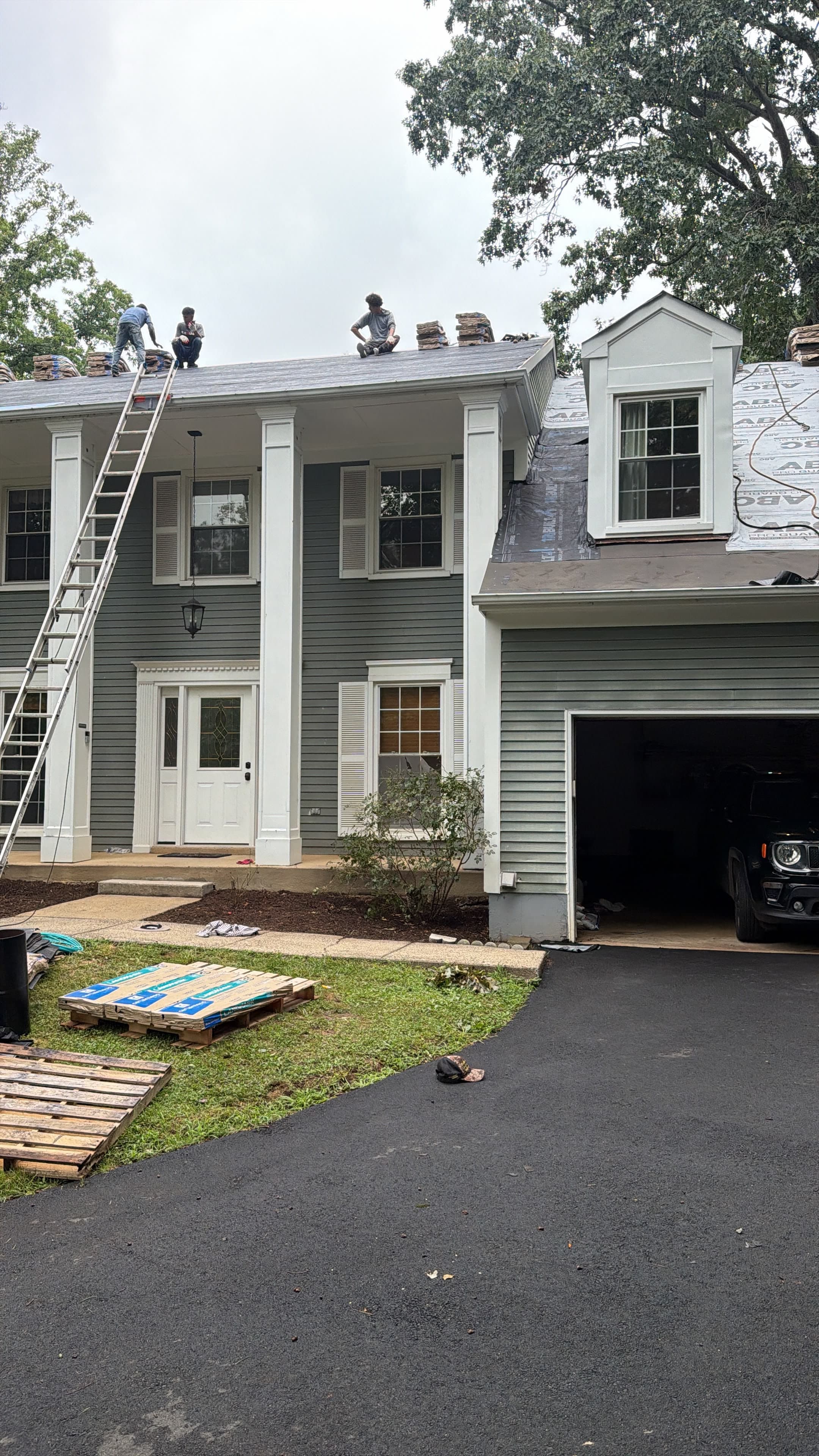
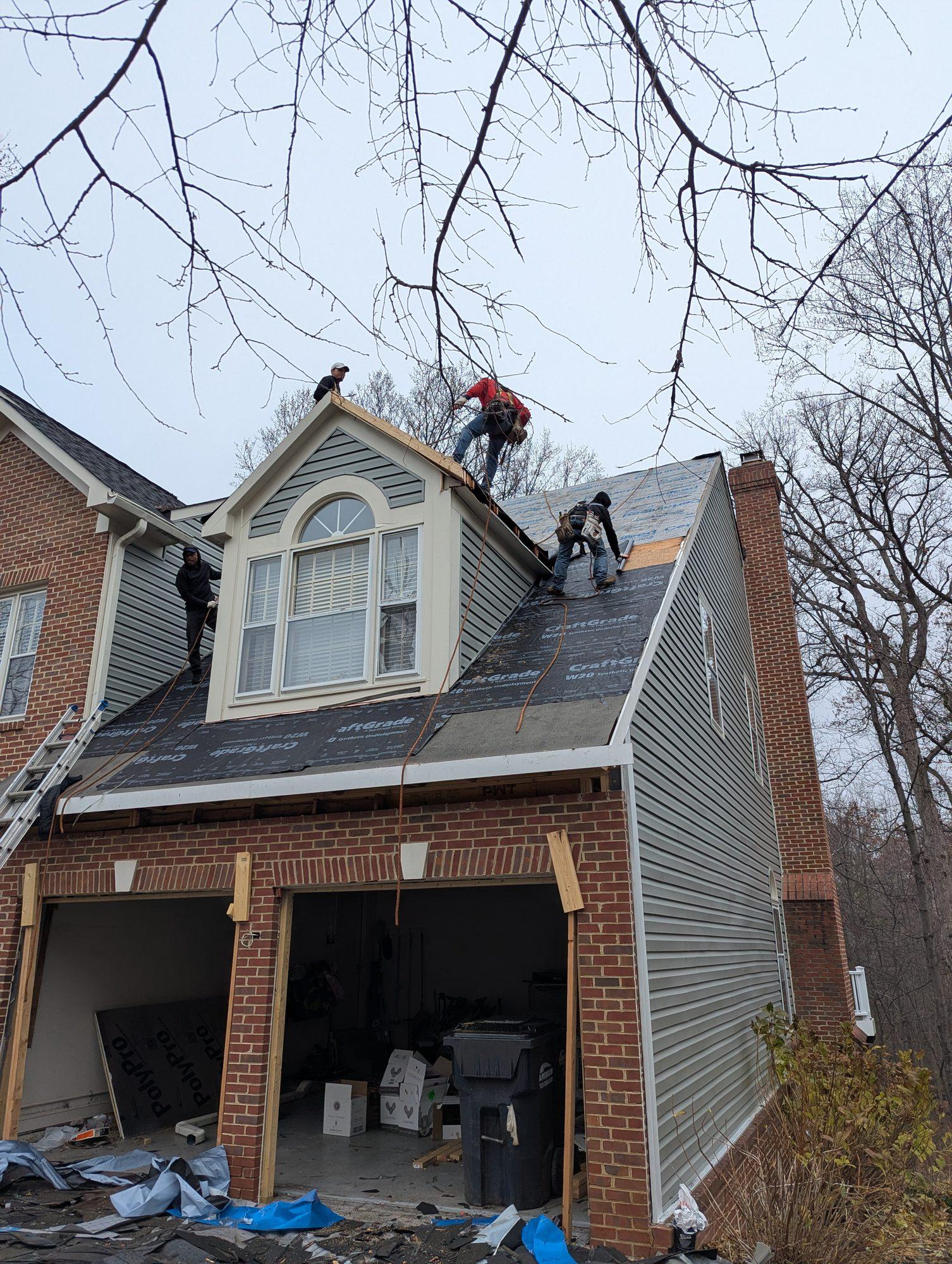
The first photo is from our Centreville project, a detached colonial, showing the underlayment stage every re-roof goes through. The second, from Reston, shows flashing work where a roof meets a vertical wall, similar to where a townhouse roof meets a taller neighbor.
Related pages
Sources and tools
Do my neighbors have to replace their roofs when I do?▸
No. Your section can be replaced on its own, tied into theirs at the party wall. Doing adjacent units together can be tidier, but it isn't required.
Who pays to fix the seam between two townhouse roofs?▸
That depends on your community's documents and on whose side the problem is. In a condominium, the association may own the roof entirely.
Will my new roof match my neighbor's?▸
It may be the same product and color, but new shingles look different from weathered ones at first. Your association may specify the product to keep the row consistent.
Is a permit needed for a townhouse re-roof?▸
Fairfax County lists shingle replacement as not needing a permit, but notes townhouse roof plywood may need to be fire rated, which can change that if decking is replaced.
Talk to a roofing company that has worked in Centreville
Call (703) 731-9208 (Monday – Saturday, 8:30 AM – 6:00 PM) or use the request-an-estimate page. The estimate is free and written, with no obligation to move forward.
Request an Estimate