
How wind actually damages a shingle roof
Asphalt shingles are held by nails and by a strip of sealant that bonds each shingle to the one below. Strong gusts get under the leading edge, lift it, and break that seal. Sometimes the shingle tears off and lands in the yard. More often it lifts, creases along the nail line and settles back down, looking fine from the street while it's no longer sealed. The next windstorm then takes it, along with its neighbors.
Damage tends to start at the edges: the rakes along the gable ends, the eaves, and the ridge caps. Older shingles, whose sealant has aged and whose mat has stiffened, let go more easily than newer ones.
Where to look on a Centreville home
- End units of a townhouse row: the exposed rake takes the brunt of wind coming across open ground or parking lots.
- Ridge caps on two-story colonials, the highest and most exposed part of the roof.
- Roof areas under mature trees, where branches can scrape or puncture shingles.
- Anywhere you can see a different-colored patch: that's exposed underlayment or deck.
What you can check safely from the ground
- Walk the yard and count shingle pieces and ridge-cap pieces. Photograph them.
- Use binoculars or a phone zoom from across the street to look for gaps, lifted tabs and dark patches.
- Check the gutters and downspout outlets for heavy granule wash.
- Look at ceilings on the top floor and, if you can do it safely, in the attic for fresh water stains.
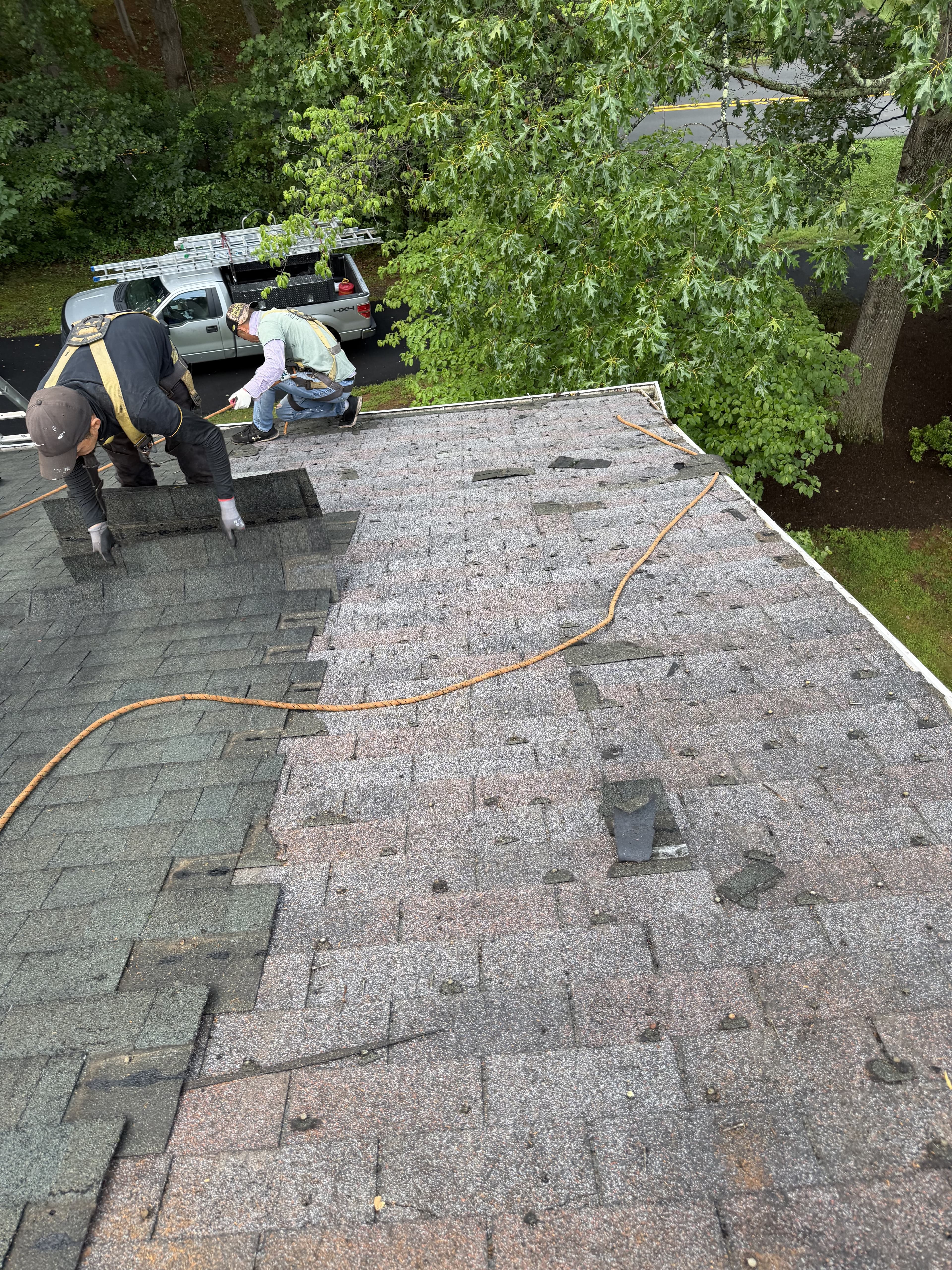
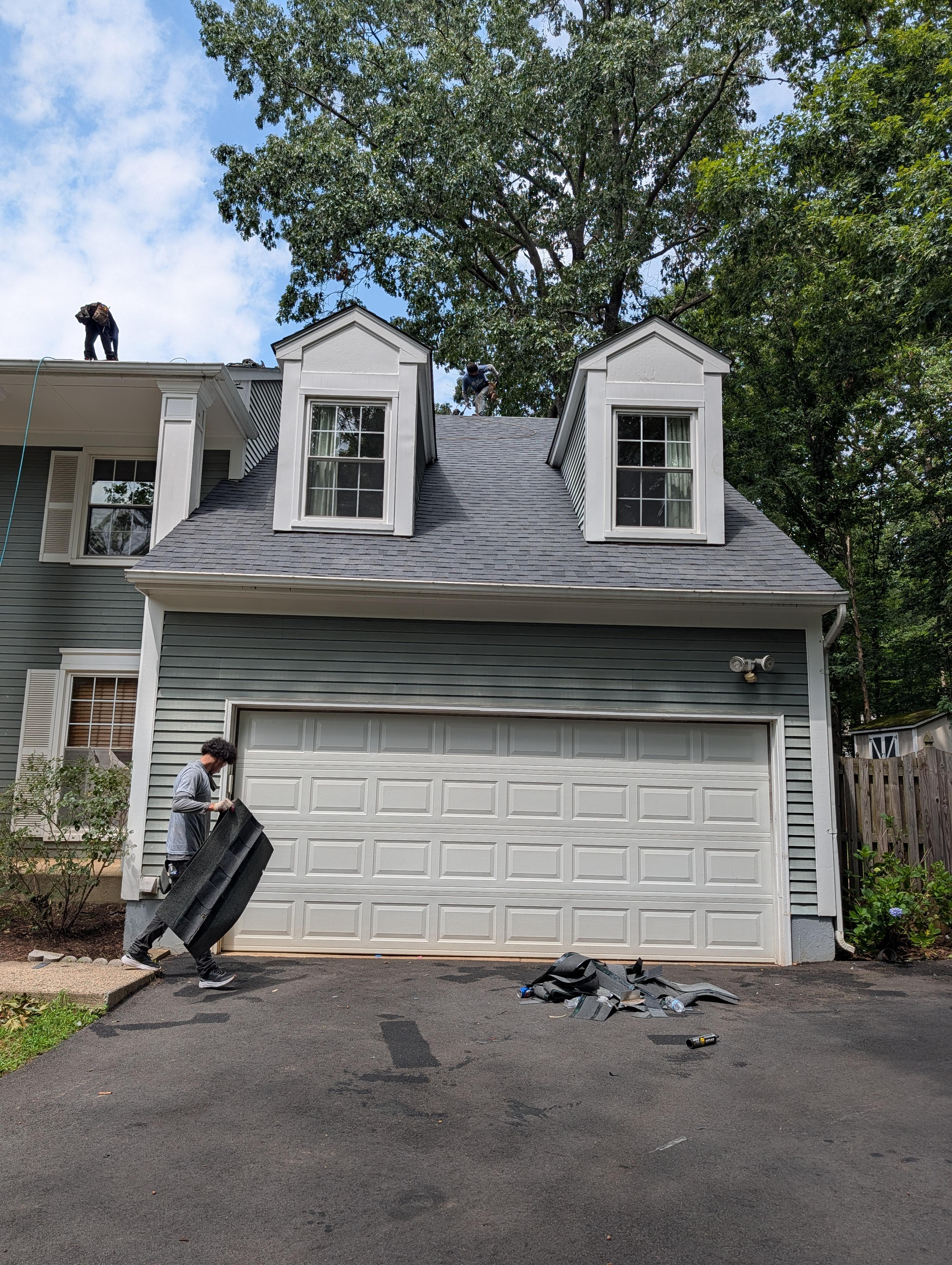
Don't climb onto the roof. Wind-damaged shingles can slide, and a wet roof is dangerous even for professionals without fall protection. Our Centreville crew worked in safety harnesses, as the project photos show.
Repair or replace after wind damage
A handful of missing shingles on a roof that's otherwise in good shape is usually a repair: replace the missing pieces, re-seal lifted ones that are still sound, and check flashing nearby. Replacement comes into the conversation when damage is spread across many slopes, when the shingles are brittle enough that repairs crack the surrounding ones, or when the roof was already near the end of its 20-to-30-year life. Matching matters too: if your shingle is discontinued, a repair may show.
Insurance
If damage is significant, call your insurer to ask how they want a claim started, and have the roof assessed so the damage is documented before temporary fixes hide it. Roofing Roughnecks assesses and documents storm damage to support a claim and coordinates timing with your insurance process. Your insurer decides coverage. On a townhouse row, compare notes with neighbors and your association; damage often crosses the property line.
After the storm: who knocks on your door
Wind events bring out-of-area crews going door to door. Before signing anything, read our guide on choosing a local roofing company over a storm crew. Fairfax County has specific advice for residents in exactly this situation.
Related pages
Temporary protection while you wait
If shingles are missing and rain is forecast, the exposed area needs protecting. A roofer can secure a tarp or make a temporary repair; tell your insurer if you go that route and keep the receipts and photos. Inside, move belongings away from any drip, put down buckets and towels, and if a ceiling is bulging with water, keep people out from under it. Temporary protection is about limiting damage, not fixing the roof, so plan the permanent repair soon after.
Preventing the next blow-off
- Fix lifted or missing shingles promptly; a gap lets wind get under the next course.
- Keep trees trimmed back from the roof.
- On a replacement, make sure the scope covers proper starter strips at the eaves and rakes, which help hold the edge shingles down.
- Check the roof from the ground after any significant wind, especially on end units.
Sources and tools
Is one missing shingle an emergency?▸
Not usually, but don't leave it. The exposed area can let water in during the next rain, and the shingles around it are more likely to go next.
Can lifted shingles be re-sealed?▸
Sometimes, if the shingle isn't creased or torn and is still flexible. Creased or brittle shingles should be replaced.
Why do end units lose more shingles?▸
The exposed rake edge takes more wind than a roof sheltered between two neighbors.
Should I call my insurer or a roofer first?▸
Either order works. Your insurer will explain how to start a claim; a roofer's assessment documents the damage.
Talk to a roofing company that has worked in Centreville
Call (703) 731-9208 (Monday – Saturday, 8:30 AM – 6:00 PM) or use the request-an-estimate page. The estimate is free and written, with no obligation to move forward.
Request an Estimate